
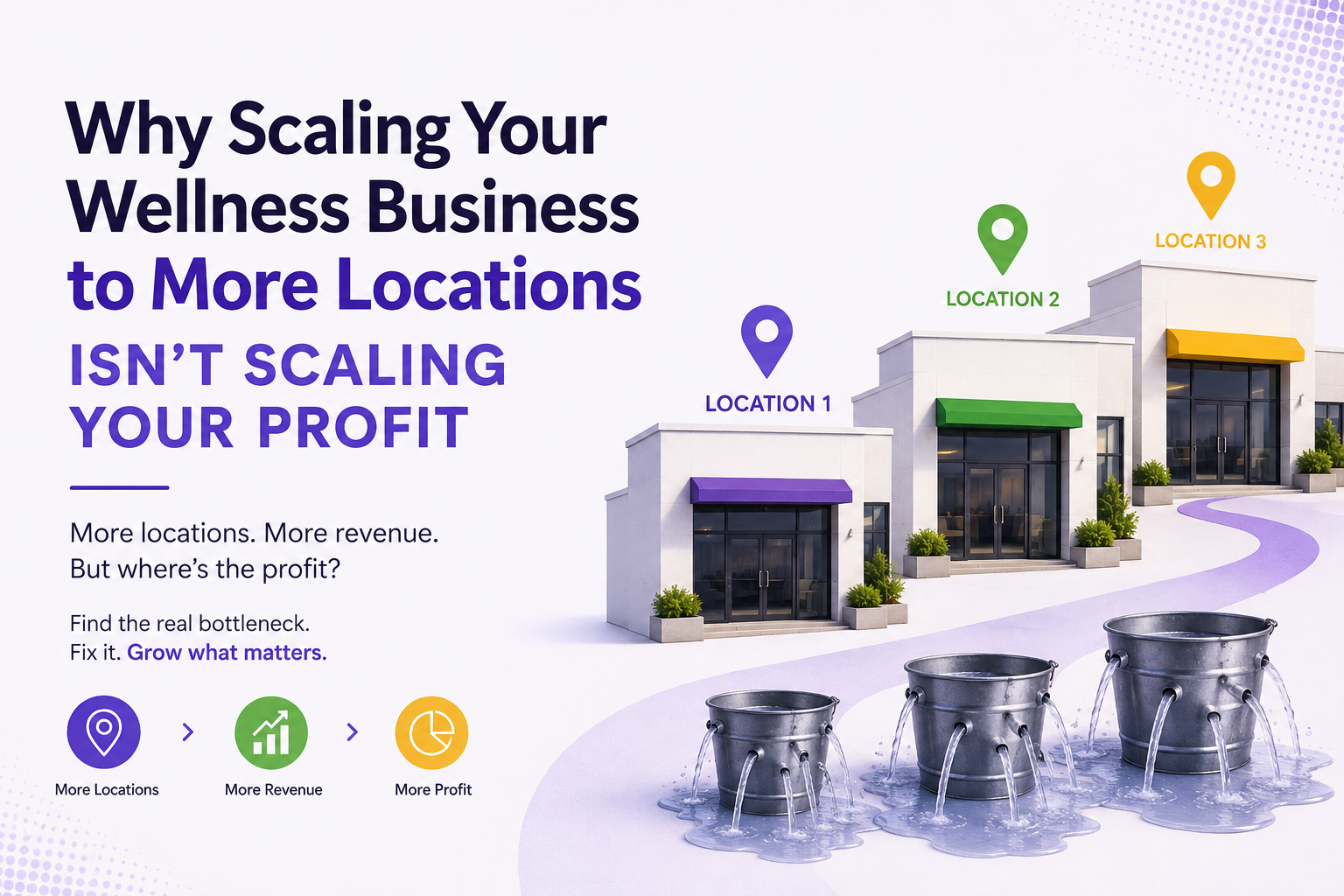
Why Scaling Your Wellness Business to More Locations Isn’t Scaling Your Profit
You have a profitable health and wellness business. You scaled beyond a single location, expecting profit to grow right alongside it, maybe even on a clean 1:1 ratio. Instead, growth in revenue hasn’t translated into growth in profit, and it’s not obvious why.
If that’s where you are right now, here’s the framework I use with multi-location wellness and longevity clients to find the real bottleneck and fix it.
Step 1: Build Margin in Your Schedule to Work On the Business
The first move isn’t a spreadsheet — it’s your calendar. You need enough breathing room in your working schedule to step back from delivering care and start examining how the business actually runs.
As you create that space:
- Tune in to where your gut tells you the bottlenecks are, and start investigating.
- Make sure someone is dedicated to owning your accounting and financial data. This can’t be an afterthought.
- Form a hypothesis, then check it against your monthly results. If it’s wrong, that’s fine. Refine it and go again.
Step 2: Read Your P&L Across Multiple Time Periods
When I first look at a profit and loss statement (P&L), I zoom in and out across time periods like a microscope. I’ll look at the full prior year, then year-to-date, then the most recent month or quarter. That range shows me how the P&L is evolving, not just where it sits today.
Do the same with your business: pull your P&L for the last 24 months, broken out by month. What trends show up that you can’t see in a single snapshot?
Step 3: Get Granular: By Location and By Service Line
To actually diagnose the problem, your data needs to go deeper than a single company-wide number. At minimum, you need:
- Revenue by product or service, and by location
- Cost of goods sold (COGS) by product or service, and by location, wherever possible
This granularity is table stakes once you’re operating more than one location. Without it, you’re left trying to explain underperformance with anecdotes instead of evidence and that rarely leads anywhere useful.
Form a hypothesis, then use the data to test it. If you get stuck, go back to the data with an open mind and let it tell you its own story, rather than forcing it to confirm what you already believe.
A Real Example: Why One Location Outperforms the Others
Say Locations 2 and 3 run a 25% profit margin, while Location 1 runs 35%. That gap is a prompt to ask: what’s actually different about Location 1?
Often, the answer is presence. You’re physically at Location 1, but not at Locations 2 or 3. That leads to the next question: what does your presence there actually change?
- Are you the one placing inventory orders at Location 1?
- What does the gross margin look like at each location?
If gross margin is higher where you’re present, it’s likely that inventory or service delivery costs are being managed more tightly there than at the other locations. In practice, this usually comes down to one of two things:
- Time inefficiency: more staff time going into the same service output.
- Cost inefficiency: paying more for the same service, or inventory waste driving up COGS.
Turn the Data Into a Story, Then Into Action
These examples all point to the same underlying process: get clean, granular data, build a P&L that’s actually useful, and form a hypothesis around the story that data is telling you. We make sense of our world through stories, and business is no different. The data points you in a direction; it’s up to you to interpret what it means and decide what to do about it.
Once you’ve traced the story back to a root cause, the next step is action and less is more. At my firm, we limit ourselves to no more than three priorities coming out of each monthly performance review, so the actions actually get done before the next one rolls around.
The Bottom Line: Financial Fitness Is a Discipline, Not a Quick Fix
Build a process like this and repeat it monthly. You’ll be astounded by the results within 12 to 18 months. It’s not a quick-win strategy, though quick wins do happen along the way, it’s a discipline, the same way physical fitness is.
None of it works without good data. Starting this process with bad data is like putting sugar in the gas tank — it simply won’t run. Start with clean, granular financial data, apply this discipline consistently, and the returns compound.
Is your multi-location wellness or longevity business hitting this same wall?
This is exactly the kind of diagnostic work our CFO advisory team does with multi-location wellness and longevity operators every month. If you’re scaling locations but not profit, schedule a discovery call to see what your P&L is actually telling you.
About the author: Chase DuBois is the Founder and Managing Principal of AdvisorOne, a tax, finance & accounting, and CFO advisory firm helping multi-location health, wellness, and longevity businesses turn financial data into a repeatable path to profitability.
FAQ
Why doesn’t profit scale at the same rate as new locations? New locations add revenue immediately but often add cost and complexity before the owner’s oversight and systems catch up. Which is why profit margin, not just revenue, is the number to track location by location.
What financial data does a multi-location wellness business need to diagnose profit problems? At minimum, revenue and cost of goods sold broken out by location and by service line, reviewed monthly across multiple time periods (prior year, year-to-date, and most recent month or quarter).
When should a growing wellness or longevity clinic bring in a fractional CFO? Typically once a business operates two or more locations and the owner can no longer personally track granular P&L performance at each site. That’s usually when anecdote stops being a reliable substitute for data.
Speak with an advisor today to see how our expertise can accelerate your business growth.
Schedule a Free Consultation